
Copper Alloy Bushing Manufacturer
What Is a Copper Bushing?
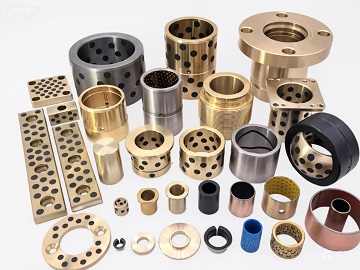
Various copper alloy bushings with different structures(straight, flanged and split) and materials(tin bronze, aluminum bronze and brass)
A copper alloy bushing is a cylindrical or specially shaped mechanical component installed between moving parts to support rotating or sliding shafts, reduce friction, distribute loads, and minimize wear between mating surfaces.
Copper alloy bushings are commonly manufactured from copper-based alloys such as tin bronze, aluminum bronze, phosphor bronze, and brass. Compared with many conventional bearing materials, copper alloys offer a combination of wear resistance, thermal conductivity, corrosion resistance, and good machinability. Depending on the application, copper bushings can be manufactured as plain sleeve bushings, flanged bushings, stepped bushings, split bushings, and other custom-designed configurations.
Copper alloy bushings offer excellent wear resistance, load-bearing capacity, and reliable friction performance under various operating conditions. Depending on the alloy composition and design, they also provide good corrosion resistance and thermal conductivity, helping reduce wear and dissipate heat during operation. Available in various materials, dimensions, and configurations, copper bushings can be custom-machined to meet specific drawing, tolerance, and surface finish requirements.
Main Applications of Copper Alloy Bushing
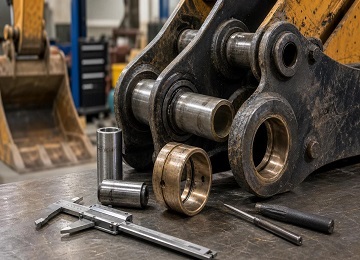
Bronze bushings for excavator boom, arm and bucket pin joints.
Copper alloy bushings rarely draw attention until a shaft starts knocking, a housing runs hot, or a liner wears through ahead of schedule. Their real job is to sit between a rotating or oscillating shaft and its support, absorb sliding contact, hold alignment, and take the wear that would otherwise reach a more expensive component. That is why they turn up across such a wide spread of machinery—wherever a steel-on-steel joint would gall, seize, or grind itself out of tolerance. In mining and aggregate processing, bronze bushings sit at the main support and eccentric points of cone crushers, ball mills, SAG mills, and rotary kilns, working under high radial loads, intermittent impact, and dust that never fully stays out of the bearing housing. The same pattern repeats in steel mills, where bushings carry rolling mill stands and conveyor lines through heat, scale, and low-speed/high-load duty. In these positions, the bushing is expected to embed grit rather than score the shaft, and to wear gradually instead of seizing without warning.
Marine and offshore service pulls the specification in a different direction. Propeller shaft bearings, rudder stock supports, seawater pump bushes, and valve trim are routinely specified in aluminum bronze or nickel-aluminum bronze, not simply because the load is high, but because the alloy has to hold up against seawater corrosion, cavitation, and erosion while remaining non-sparking for oil and gas duty. Construction and earthmoving equipment add another set of demands: articulation joints, blade lift pivots, and cylinder ends work in oscillating motion under shock and vibration, often with dirt and water present, so tin bronze remains the common choice where embeddability matters as much as load capacity. In pumps, the bushing also serves as a controlled wear point—when lubrication degrades or contamination enters, the bushing is meant to wear before the shaft does.
Not every application needs a heavy cast bronze, though. Oil-impregnated or graphite-plugged copper bushings are used in agricultural equipment, food processing machinery, textile equipment, and small motors where continuous re-lubrication is impractical, and the priority is low friction over a long service life rather than maximum load capacity. If you are unsure which duty profile matches your equipment, send over the drawing and the operating conditions—load, speed, lubrication, and environment—and Metalsin will tell you which bushing we would run, and why.
Types of Copper Alloy Bushing & Material Standard
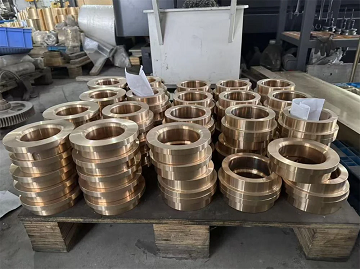
C93700 bronze bushings for heavy duty applications.
Copper alloy bushings come in a wide range of designs and materials, and the right combination depends on the application, the load, and the operating environment. In our experience, the specification usually falls along four lines: structure, material, lubrication design, and the material standard behind it. Get those four right, and the bushing holds clearance and wears predictably; get one wrong, and it fails early no matter how well it is machined.
The common structural designs are sleeve, flanged, stepped, and split bushings. Sleeve bushings are the workhorse for radial shaft support in rotating and sliding applications. Flanged bushings add axial positioning and support, stepped bushings handle assemblies that need different diameters along the length, and split bushings make installation, removal, and replacement much easier. We machine all four to drawing, and we check bore, flange, and step dimensions in a single setup so tolerance stack-up doesn’t creep in.
The materials we work with most are tin bronze, aluminum bronze, phosphor bronze, and brass. Tin bronze—C93200 (SAE 660) being the familiar grade—is the general-purpose choice for industrial bearing duty: it conforms well, embeds contaminants, and tolerates minor misalignment. Aluminum bronze (C95400, C95500) is where you go for high strength, wear resistance, and corrosion resistance under heavy load or seawater exposure. Phosphor bronze gives good wear and fatigue performance for oscillating and cyclic loads, while brass is chosen mainly for its machinability in selected mechanical applications.
Lubrication is where a lot of bushing failures are decided, so we machine three routes to drawing. Graphite-plugged bushings carry solid lubricant plugs for dry or infrequently lubricated operation. Grease-lubricated bushings use grooves or holes to spread grease across the bore, and oil-lubricated bushings are built around an external oil system for continuous service. Groove pattern, plug layout, and hole position are all cut and checked before the part ships.
Bushings can be manufactured to ASTM, EN/DIN/BS, JIS, and GB/T, with the grade chosen according to alloy composition, casting process, mechanical properties, and operating conditions. On the ASTM side, the usual specifications are B271/B271M for centrifugal castings, B505/B505M for continuous castings, B584 for sand castings, and B148 for aluminum-bronze sand castings; typical grades include C93200/C93700 for tin bronze and C95400/C95500 for aluminum bronze. Under EN 1982 / DIN EN 1982 / BS EN 1982, we regularly cast CuSn12-C (CC483K) and CuAl10Fe5Ni5-C (CC333G). JIS H 5120 covers grades such as CAC406 and CAC702, and GB/T 1176 covers casting copper alloys including ZCuSn10Pb1.
Copper Alloy Bushing Manufacturing Process
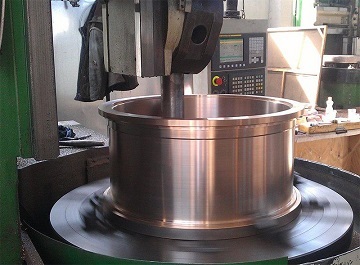
Centrifugal casting process for straight copper bushings.
Our copper alloy bushing manufacturing covers centrifugal casting, sand casting, metal-mold casting, and investment casting, selected according to the bushing’s wall thickness, load regime, and geometry. Metalsin operates our own melting and alloying furnace, so grades such as ZCuSn5Zn5Pb5, ZCuAl10Fe3, ZCuSn12, lead bronze, and brass are poured to the specified chemistry rather than sourced as generic “bronze.” Centrifugal casting is our preferred route for rotating and high-load bushings: it drives denser metal toward the mold wall and forces gas and oxides inward, producing a pore-free structure with higher density and wear resistance than sand-cast parts, and eliminating sand-gas porosity defects. We cast bushings from φ40 mm to φ5000 mm, with centrifugal casting available up to φ3000 mm and single-piece weights from 0.1 kg to 5000 kg—covering everything from small precision sleeves to large crusher and mill bushings.
After casting, every bushing is machined to drawing, with the bore finished only after the casting has stabilized. We machine oil grooves, lubrication holes, and graphite plug patterns, and hold ID/OD tolerance to ±0.01 mm on precision parts, with concentricity and roundness verified by CMM. Production is tracked through an SDG production scheduling system from batch progress and quality control to inspection and shipment, and each lot ships with heat-traceable material certificates and dimensional reports. Customers can send a drawing or a physical sample—we quote against the drawing and return a bushing that maintains clearance, resists seizure, and wears predictably in service.
Click to view more copper alloy bushing:
| Centrifugal Cast Bronze Bushings for Cone Crushers |
| Bronze Spline Bushings for PTO Shafts |
| Flanged Bronze Bushings with Thrust Face for Port Cranes |
| Continuous Cast Bronze Bushings for Injection Molding Machines |
| Graphite Plugged Bronze Bushings for Sugarcane Equipment |
| Aluminum Bronze Bushings for Offshore Winches |
| Custom Bronze Bushings Per DIN 1850 |
| OEM Bronze Bushings Manufacturer for Heavy Equipment |
| Tin Bronze C93200 Bushings Supplier for Pump Repair |
| Phosphor Bronze Guide Bushings for Mold & Die Applications |
Inspection for Copper Alloy Bushing
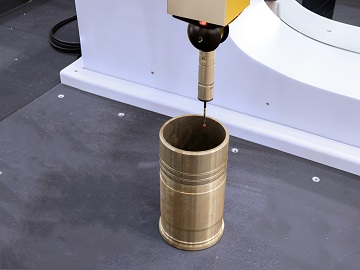
Precision CMM inspection for bronze bushing.
At Metalsin, we implement a strict, ISO 9001-compliant inspection process from raw material to final delivery. We begin with spectrochemical analysis and hardness testing to verify alloy composition and eliminate casting defects. During CNC machining, real-time dimensional and geometric tolerance checks via CMM ensure a perfect fit (with careful measurement of the metal base to avoid graphite areas). Surface roughness is tested to minimize friction, while Ultrasonic Testing (UT) is applied to heavy-duty and bi-metal bushings to guarantee internal integrity and layer bonding without delamination. For self-lubricating bushings, we rigorously inspect the bonding strength and uniform distribution of graphite plugs. Before shipment, every order undergoes final inspection and is supported by third-party checks (SGS/BV), accompanied by full Material Test Certificates (MTC) for 100% traceability.
CATEGORY AND TAGS: